05The story
Stone, tile and iron
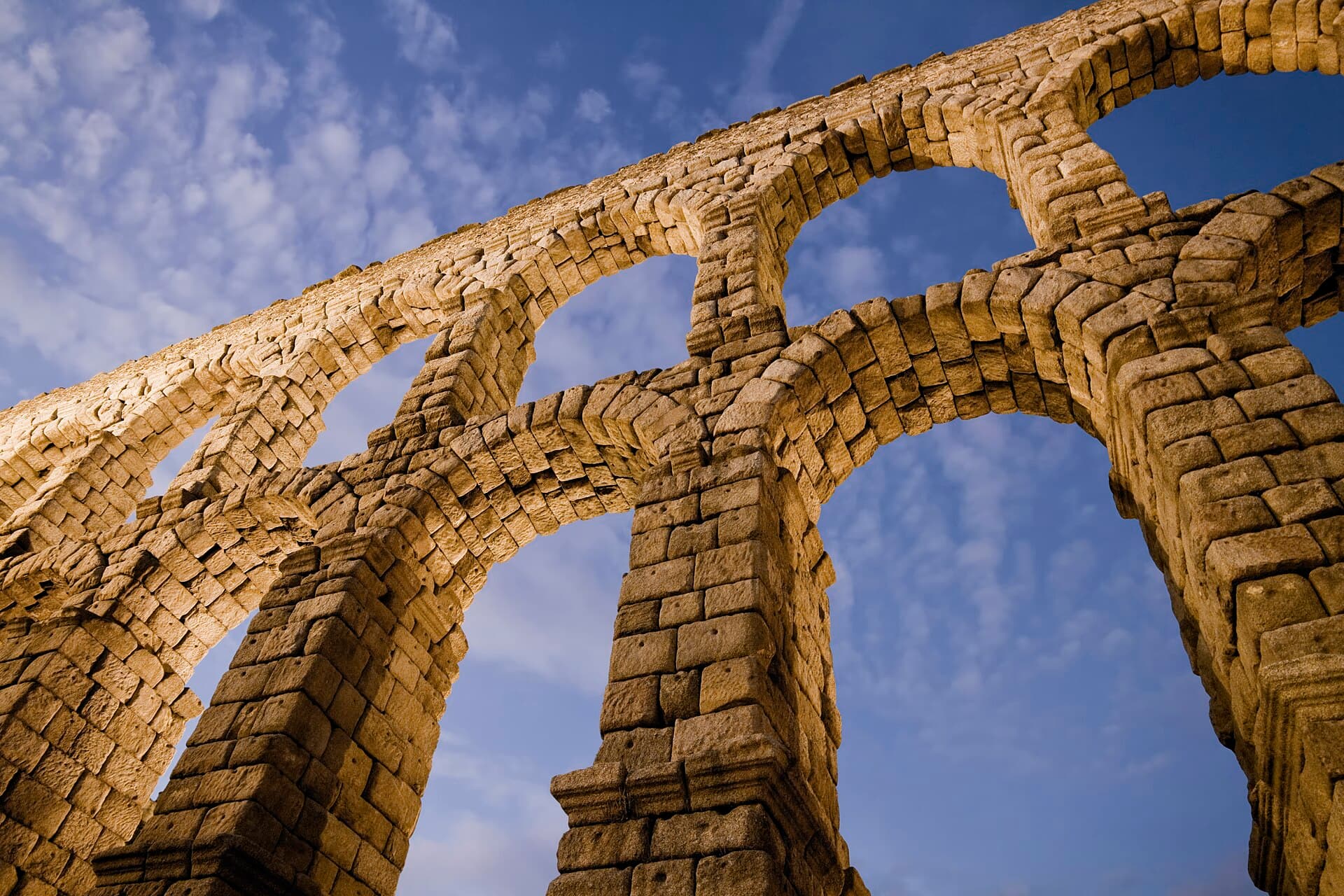
What you walk through in these cities is not one age. A Roman aqueduct still stands in Segovia, a tower was finished in 1198 in Seville, a Mudéjar palace dates from the fourteenth century, then Madrid’s palace in the eighteenth, then Gaudí’s buildings, then Bilbao’s museum in 1997, then the volcano’s park on the World Heritage List in 2007. The line follows the building, not events a traveller does not need.
First century
The Segovia aqueduct carried water about 17 kilometres, and its elevated section has 167 arches. It stayed in use until 1973, and the old city and the aqueduct have been listed since 1985.
1198
On 10 March 1198 the Giralda was finished with its metal crown. The belfry was added in the sixteenth century.
Around 1365
In the 1360s the Mudéjar wing of Seville’s palace was built. The site had been a fortress since the tenth century.
1738
After the fire of 24 December 1734, Madrid’s palace was built between 1738 and 1755, on more than 135,000 square metres.
1882
On 19 March 1882 the foundation of the Sagrada Família was laid. The building is unfinished, and the planned height is 172.5 metres.
1914
Park Güell opened as a public garden on the slope of Carmel hill, and entered the World Heritage List in 1984.
1928
The building of Plaza de España in Seville was finished for the 1929 exposition in María Luisa Park.
1984
The first five sites, among them the Alhambra and Park Güell with Palau Güell and Casa Milà.
1997
On 18 October 1997 the Guggenheim Museum opened on the Bilbao estuary.
2007
Teide National Park, 189.9 square kilometres, was inscribed on the World Heritage List.