03Places
The Guadalquivir
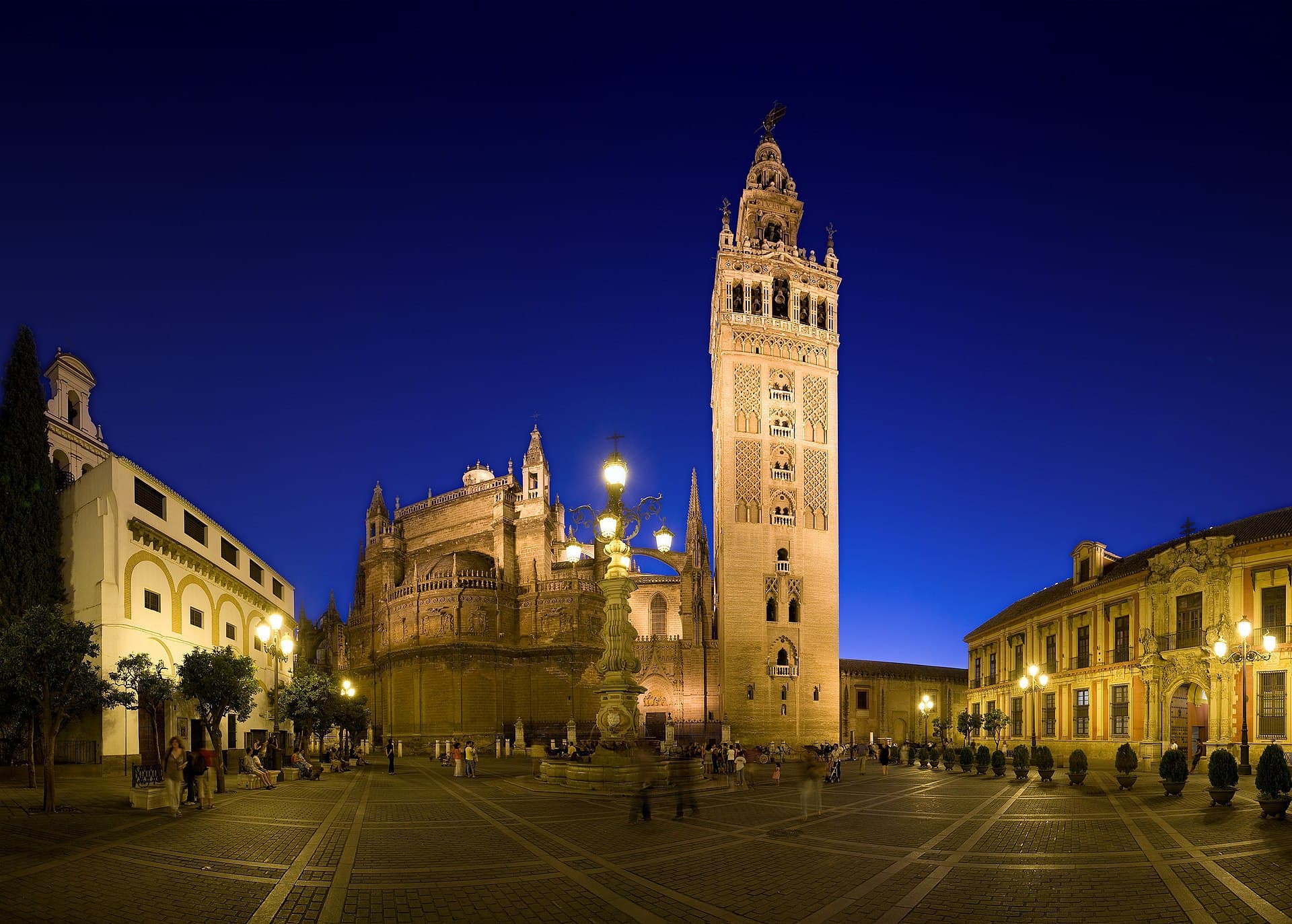
Seville and its tower
Seville is the capital of Andalusia, on the lower Guadalquivir in the south-west of the mainland. The municipality had 686,741 residents in 2024, covers 140 square kilometres, and sits at about 7 metres. The river is 657 kilometres long, the second longest that runs entirely in Spain, and the only large river still used by ships. Today those ships sail from the city to the Gulf of Cádiz. Summers here are long, hot and dry, and winters are milder with moderate rain. The valley is often called the country’s frying pan, and Seville is the warmest city in continental Europe. Long walks in July and August belong to the morning or the evening. The Giralda is the bell tower of the cathedral. It was built as a minaret and finished on 10 March 1198 with a crown of metal spheres, then given a belfry in the sixteenth century. In 1987 it was listed together with the cathedral, the Alcázar and the Archive of the Indies as one site. The palace itself stands on a tenth-century fortress, and its most important wing is a Mudéjar palace decorated in the 1360s under Peter I. Plaza de España was completed in 1928 for the 1929 Ibero-American Exposition, inside María Luisa Park, with arches and tiles for the provinces. The city’s airport handled 9,075,172 passengers in 2024.
- 0 residents in 2024.
- Population
- 0 square kilometres.
- Area
- 0 kilometres, navigable from Seville to the gulf.
- Guadalquivir