03Places
The Mediterranean
Barcelona and Gaudí
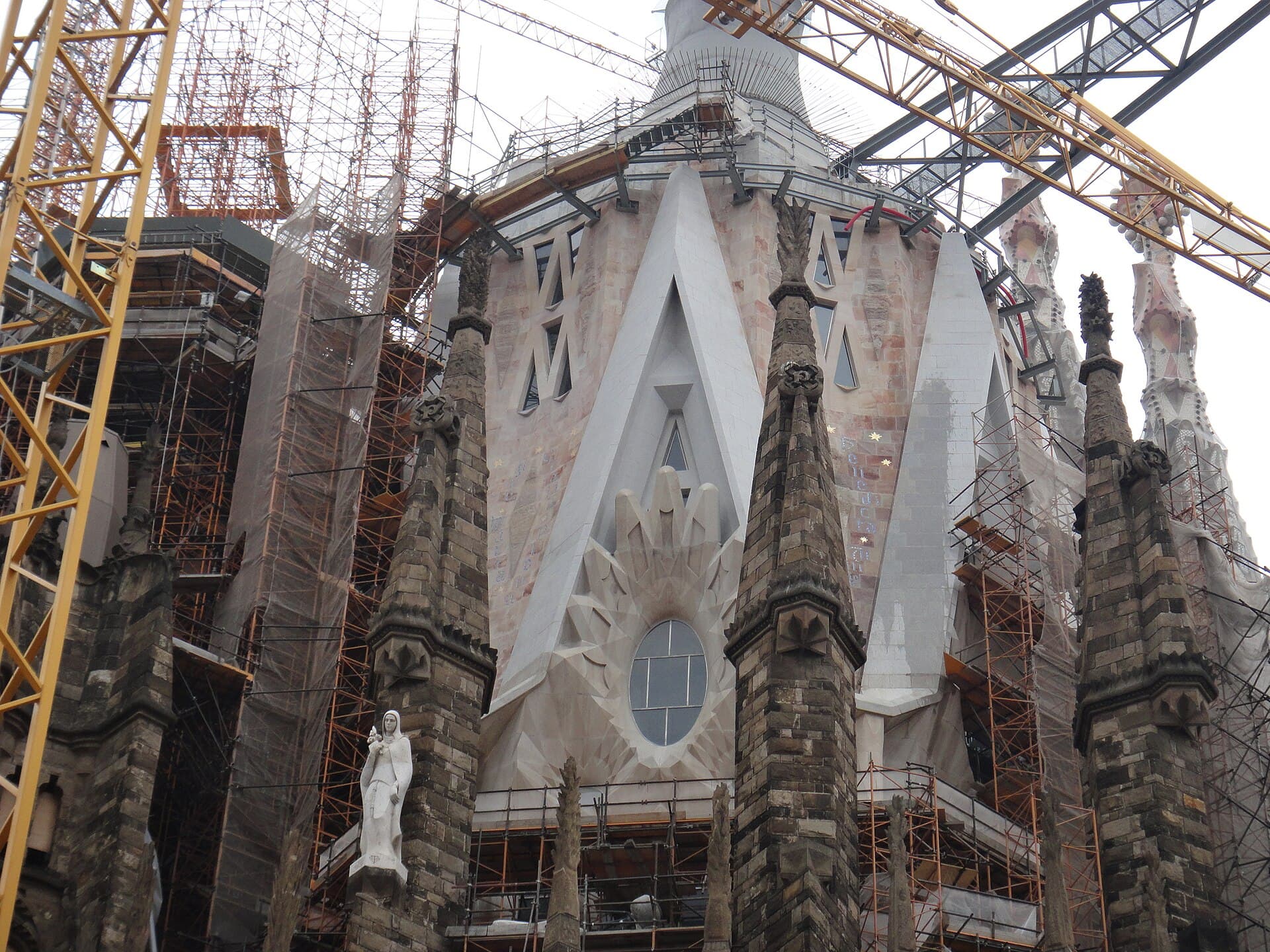
Barcelona stands on the north-eastern coast, the capital of Catalonia and the country’s second city after Madrid. It had 1,713,247 residents in 2025, covers 100.68 square kilometres, sits at about 12 metres in the centre, and reaches 512 metres at Tibidabo, the highest point in the municipality. It lies between the mouths of the Llobregat and the Besòs, with the Collserola range to the west. Summers are hot, winters milder, rain is heavier in autumn and spring, and the dry spell in summer is short. The Sagrada Família is a basilica designed by Antoni Gaudí. The foundation stone was laid on 19 March 1882, and the work is still going on, which is why the cranes in the photograph belong to the building. The planned height, including the cross on the tallest tower, is 172.5 metres, which would make it the tallest church in the world by that measure. In 2005 parts of it were added to the Works of Antoni Gaudí on the World Heritage List. Park Güell is a garden on the southern slope of Carmel hill in the Gràcia district, opened in 1914 and inscribed in 1984 within the same group. Casa Batlló is a house in the centre that Gaudí redesigned in 1904, with a scaled roof and carved balconies. La Boqueria, the Mercat de Sant Josep, is a public market in the old city with an entrance from La Rambla, near the opera house, and a wide range of goods. El Prat Airport handled 57,483,036 passengers in 2025.
- 0 residents in 2025.
- Population
- 0.68 square kilometres.
- Area
- 0.5 metres with the planned cross at the top.
- Tower height