03Places
The Canaries
Tenerife and Teide
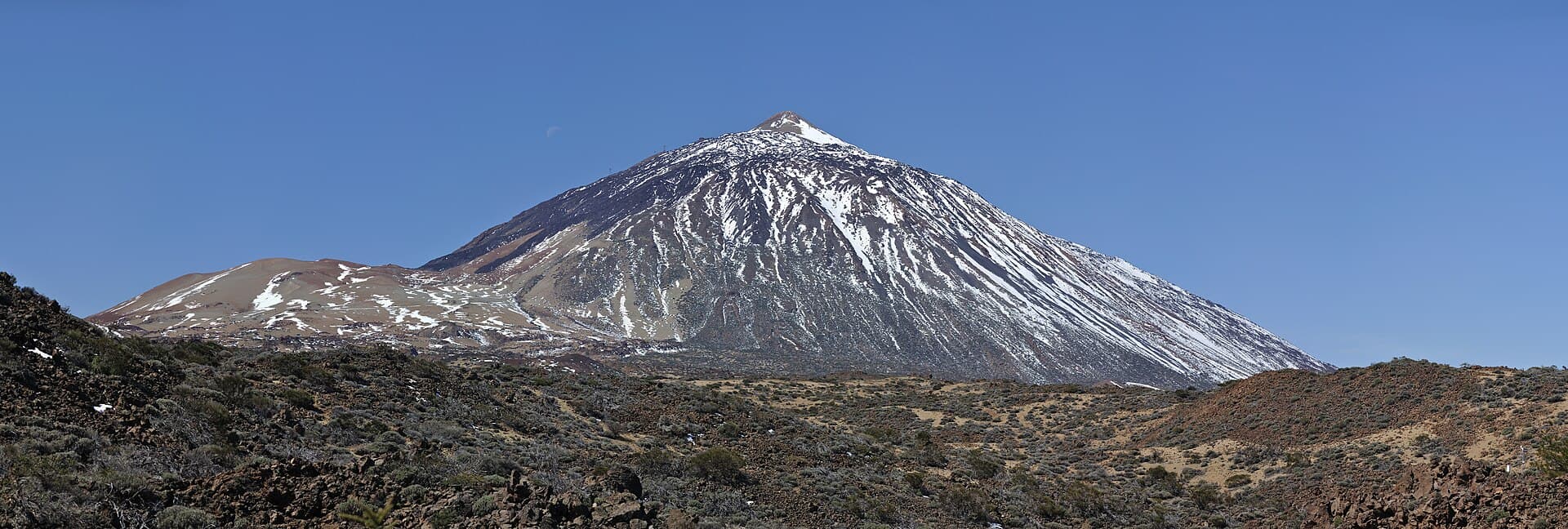
Tenerife is the largest and most populous of the Canary Islands, in the Atlantic off the north-west of Africa. It covers 2,034.38 square kilometres. The island infobox gives 974,003 people for 2026, while the opening of the same page gives 972,018. Teide dominates the island: a stratovolcano that is still known to be active, its summit 3,715 metres above the sea, the highest point in Spain and the highest point on any Atlantic island. From its base on the ocean floor the full rise is 7,500 metres. Teide National Park around the summit covers 189.9 square kilometres and was inscribed in 2007. The rock photograph shows a line of stones on the park floor with the hill behind. The coast is, on the whole, warm and dry. Winter on the beach is mild and summer is warm, while the heights around La Laguna are cooler, wetter and cloudier. Trade winds often wrap the north in cloud. The cliffs of Los Gigantes, in the Teno massif, drop to the water and mark the west of the island. San Cristóbal de La Laguna was the capital of the islands, and its old centre has been listed since 1999: an unplanned upper town and a lower town on a grid, the first unwalled Spanish colonial city, and a plan that later served as a model for cities in the Americas. The south airport, the visitors’ gate, handled 13,969,678 passengers in 2025. Days here are not mainland days: a summit, a cliff, and a city of straight streets.
- 0 in the infobox for 2026.
- Population
- 0.38 square kilometres.
- Area
- 0 metres above the sea.
- Teide