03Places
Ruins of the north-centre
Sukhothai
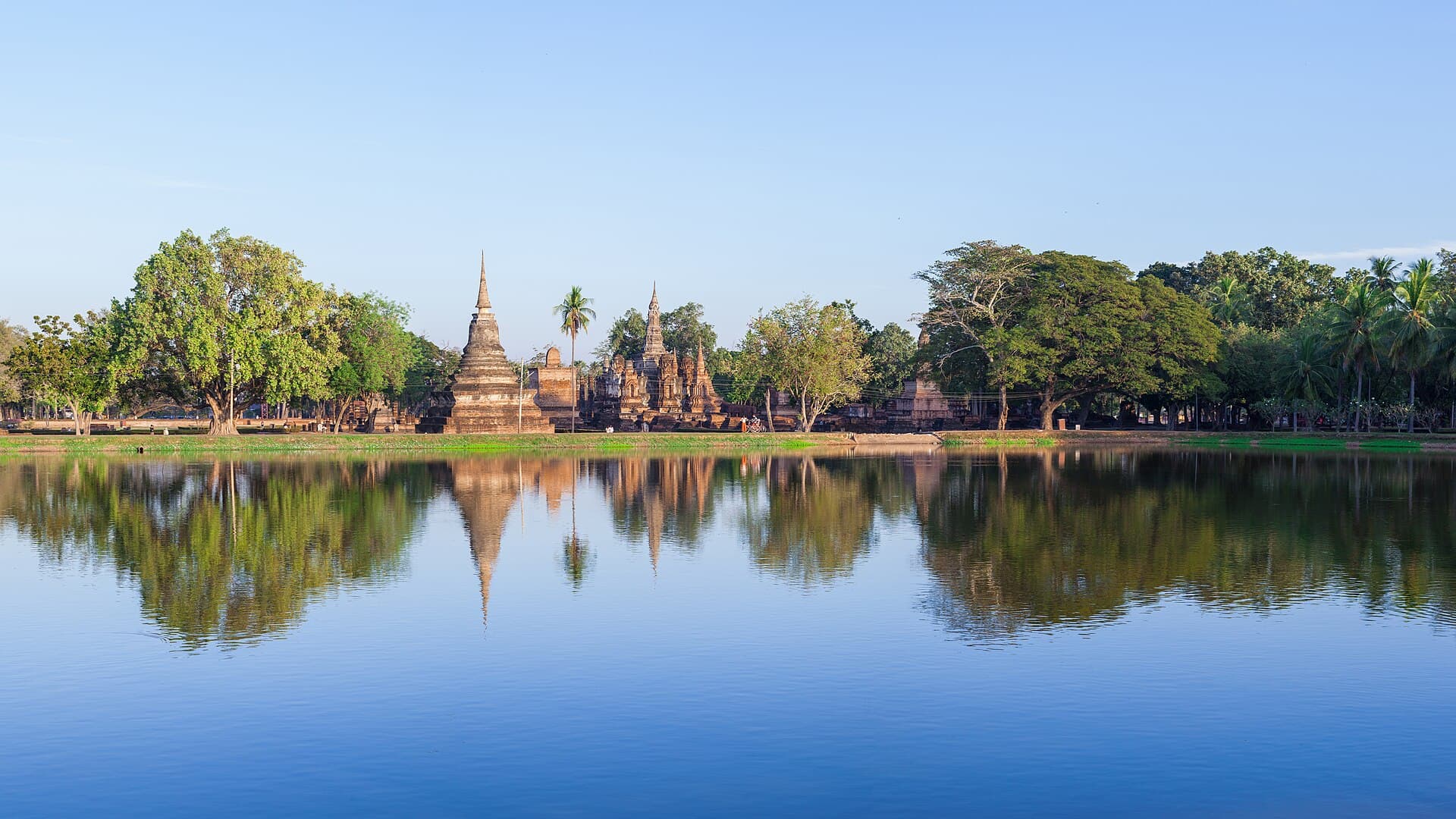
Sukhothai Historical Park covers a capital of the thirteenth and fourteenth centuries. The name means dawn of happiness. The walls form a rectangle about 2 kilometres east to west and 1.6 kilometres north to south, with a gate in the middle of each side. Across 70 square kilometres there are 193 ruins. Inside the walls are the remains of the royal palace and twenty-six temples, the largest being Wat Mahathat. It is generally held to have been founded by Sri Indraditya, then enlarged at the end of the thirteenth century and through the fourteenth. The principal stupa is conventionally dated to about 1345. Its shape is a lotus bud, and the base carries 168 stucco figures. Northwest, in the middle of Traphang Trakuan lake, Wat Sa Si has a Lanka-styled stupa and a hall on its own small island. Wat Si Chum is a square mandapa of the late fourteenth century, built by King Maha Thammaracha II. The base is 32 metres on each side and 15 metres high, the walls are about three feet thick, and a stair climbs inside the south wall. The seated figure within is 11 metres wide and 15 metres high. More than fifty engraved slates are among the oldest surviving examples of Thai drawing. The park is part of the Historic Town of Sukhothai and Associated Historic Towns, listed in 1991. Allow a full day. The lake and the tall mandapa are a walk apart.
- 0
- Ruins
- 0
- Temples inside the walls
- 0 km²
- Park area