05The story
Heritage
Saving the monuments of Nubia
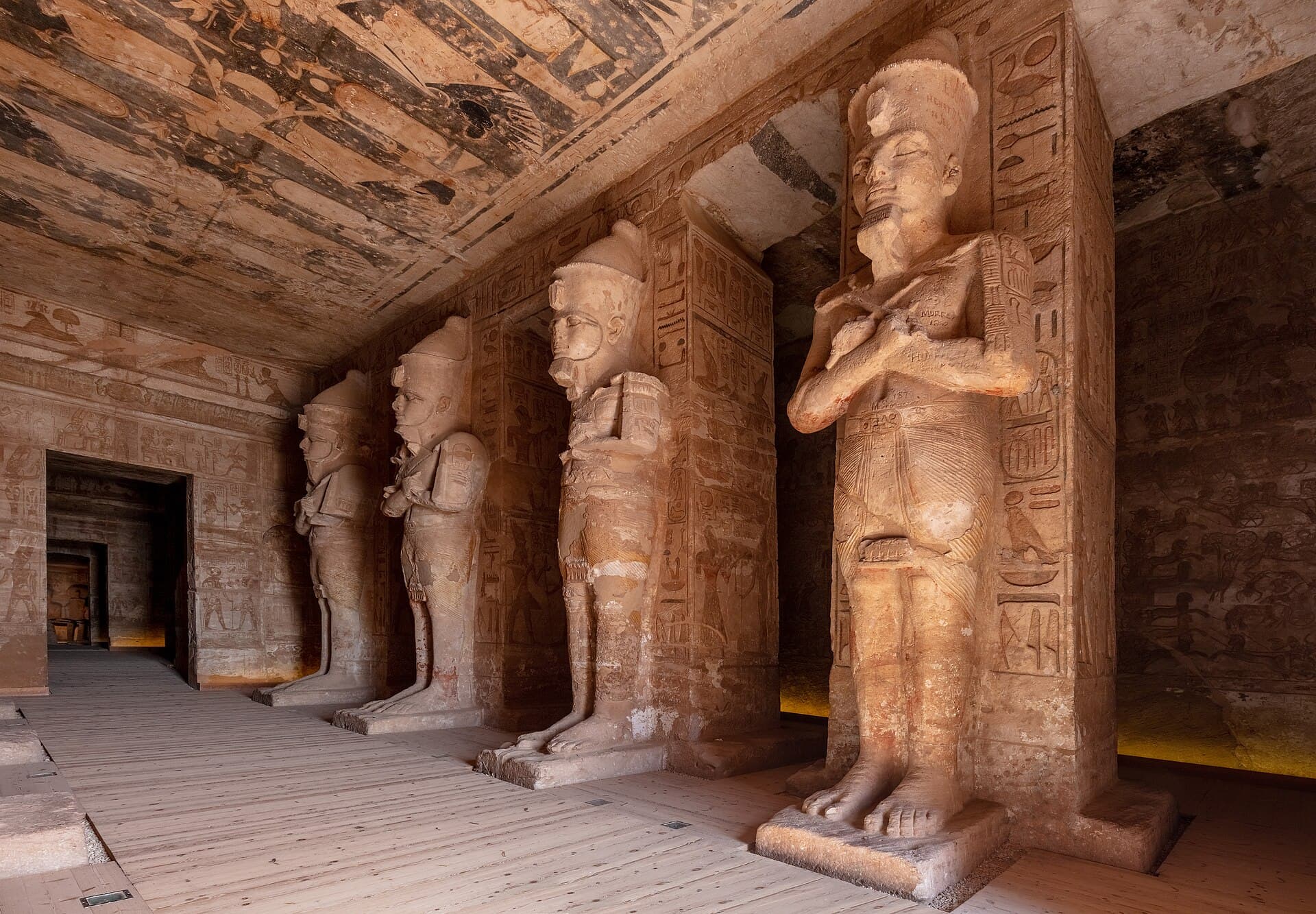
When the High Dam at Aswan was planned, it was clear that its lake would flood all of Lower Nubia for 479 km, and with it 22 important monuments, among them the temples of Abu Simbel, Philae, Kalabsha and Amada. Between 1960 and 1980 UNESCO led an international campaign joined by fifty countries, described as the greatest archaeological rescue operation of all time. At Abu Simbel the two temples were cut into 1,036 blocks, none heavier than 20 tonnes inside or 30 tonnes on the façades, lifted and reassembled on higher ground, with the cracks injected with epoxy resin to hold the fragile sandstone together. At Philae, 95 structures were dismantled and moved to Agilkia Island, and other temples went to new sites too. Out of this experience grew the idea of a heritage shared by all humanity: the World Heritage Convention was adopted in 1972, and in 1979 the rescued temples were listed as the Nubian Monuments from Abu Simbel to Philae. Standing before Abu Simbel, you face two achievements more than 3,200 years apart.
- 0
- Monuments relocated
- 0
- Countries in the campaign
- 0
- Blocks of the Abu Simbel temples
- 1972
- World Heritage Convention adopted
Highlights
- World HeritageThe campaign paved the way for the 1972 convention and the system of World Heritage Sites known today.