03Places
The capital
Roseau between river and hill
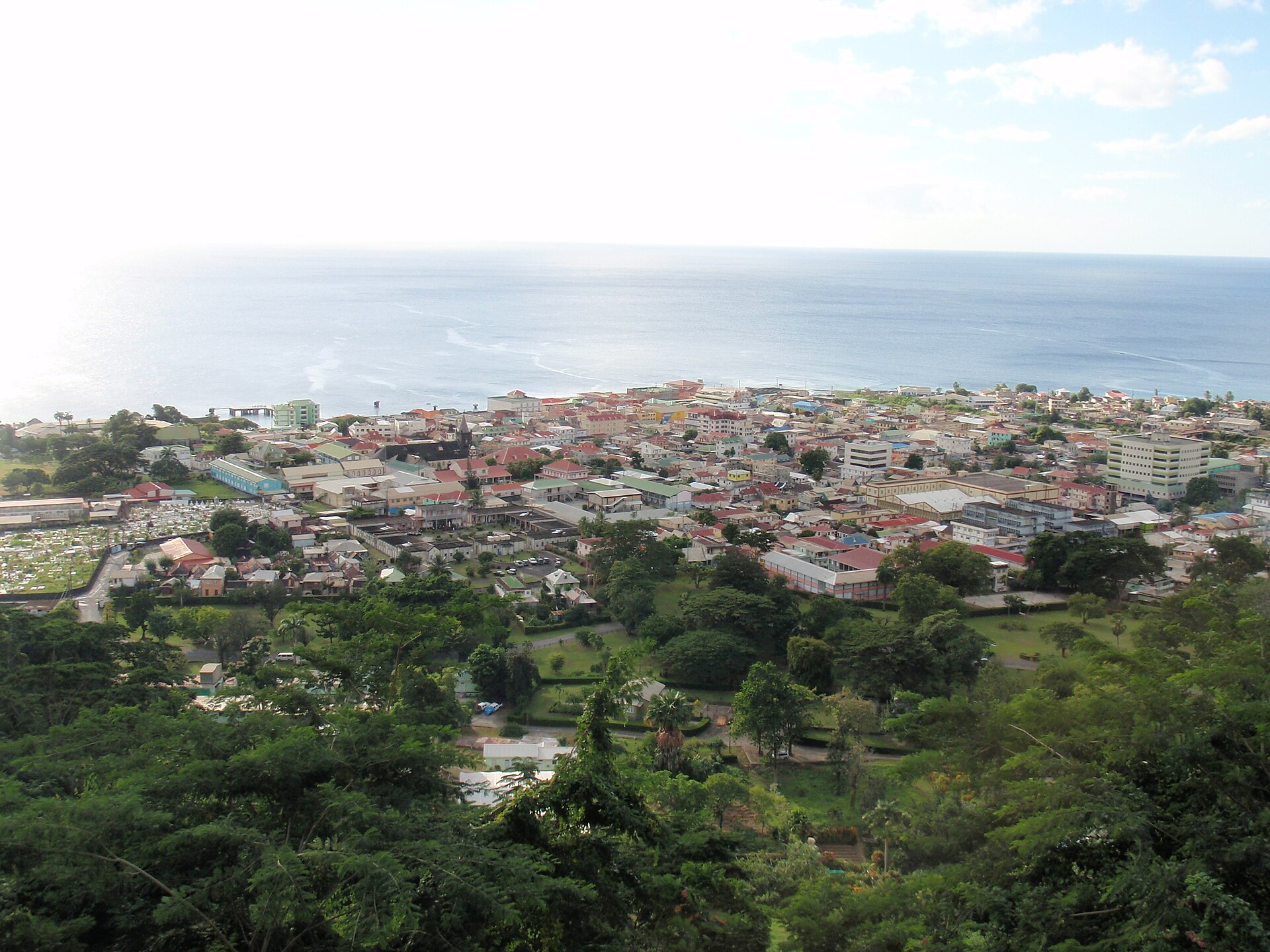
Roseau is Dominica’s capital and largest town, on the west coast in the lee of the mountains, bounded by the sea, the Roseau River and Morne Bruce. In 2011 it had 14,725 residents. It grew on the site of the old Kalinago village of Sairi, and took its name from the reeds the French found on the bank and called roseau. Streets leave the old market in a tight, irregular grid: about 80 blocks in 30 hectares, so a block is shorter than in two neighbouring Caribbean capitals, and it is easy to lose the way in the centre even though the area is small. The botanical gardens sit on the edge of that centre, 16 hectares that had been a sugar estate at Bath, with planting begun in 1890 after planning that started in 1889. They hold the national tree, the bwa kweyb, and specimens of the cannonball tree and the banyan. When Hurricane David passed in 1979 a huge African baobab fell on an empty school bus, and both the tree and the bus are still there. From the gardens, Jack’s Walk, built in the 1880s, climbs in about 15 minutes to Morne Bruce. On the hill are the remains of a barracks and a gun, and a large cross set up in the 1920s, with the town’s roofs and the harbour below. Our Lady of Fair Haven Cathedral is a building of volcanic rock in a Gothic Romanesque revival style. Its present form is dated 1916, and the formal consecration was in 1925. The tower carries a clock, and the upper windows are stained glass. Canefield Airport is 5 kilometres north of town, opened in 1981, with a single runway 954 metres long, so the longer international flights land at Douglas–Charles on the other coast. Annual rain in Roseau is nearly 1,800 millimetres, and February, March and April are less wet without any of them going dry.
- 0 people in 2011.
- Population
- About 80 blocks in 30 hectares.
- Town centre
- 0 hectares; planting began in 1890.
- The gardens
- About 1,800 millimetres a year.
- Rain