05The story
Architecture
Zellige and riads
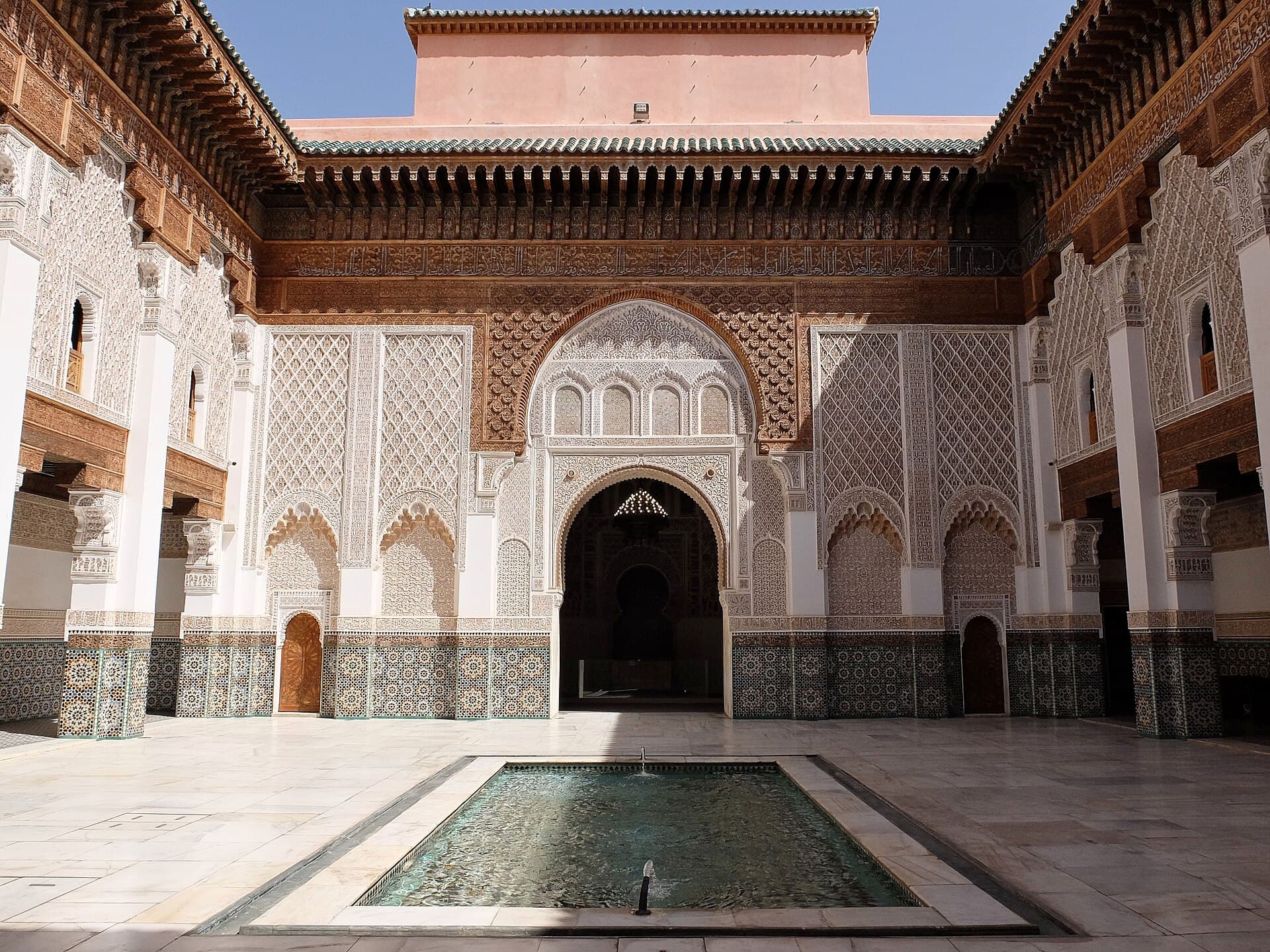
Zellige is a mosaic of glazed tile pieces, each chiselled by hand in its own colour and fitted together into geometric patterns, the most famous being radiating stars built from polygons. From the 14th century it became a standard feature on lower walls, in fountains and pools, on minarets and across floors. After the 15th century it faded out almost everywhere except Morocco, where it is still made today. Its name comes from the Arabic verb for 'to slide', a nod to the smooth glazed surface. The finest examples are in the old madrasas: Bou Inania in Fez, built in 1350–1355, and Ben Youssef in Marrakesh, built in 1564–1565, where zellige at the base gives way to carved plaster and then to carved wood higher up. A riad is an inner garden, a rectangle split by crossing paths into four parts with a fountain at the centre; today the word also means a traditional house turned guesthouse. The Bahia Palace brings all of these together. In each courtyard, look at the floor, the walls and the ceiling in turn.
- The 14th century
- Standard feature since
- 0–1355
- Bou Inania built
- 0–1565
- Ben Youssef built